Industri Laser: AI dan Otomasi Mengubah Manufaktur Global Teknologi industri laser memasuki era baru dengan AI, otomasi, dan fotonik cerdas. AKL 2026 mengungkap tren pasar, pertumbuhan industri, hingga masa depan manufaktur global.
Penulis/editor: Rayendra L Toruan
TechnoMachinews.id – Fraunhofer ILT (sumber): Penjelasan berikut merupakan alasan mengapa laser berbasis AI diprediksi menjadi teknologi paling menentukan dalam revolusi industri berikutnya.
Teknologi industri laser memasuki babak transformasi baru. Dalam AKL’26 – International Laser Technology Congress yang digelar di Aachen, Jerman, beberapa waktu lalu.
Para peneliti, produsen, dan pelaku industri sepakat bahwa masa depan laser berkaitan dengan teknologi yang menghadirkan daya yang lebih besar, dan masuknya kecerdasan buatan (AI), otomasi, dan sistem yang mampu mengambil keputusan secara mandiri.
Perkembangan tersebut membuka peluang besar bagi sektor mikroelektronik, energi, otomotif, kedirgantaraan, hingga teknologi medis sekaligus menjadi fondasi lahirnya generasi baru manufaktur pintar.
Peningkatan otomatisasi dan aplikasi baru saat ini membentuk teknologi laser industri. Khususnya di bidang mikroelektronika, energi, kedirgantaraan, dan teknologi medis, laser berkinerja tinggi dan teknologi fotonik membuka prospek pertumbuhan baru.
Perkembangan yang mendorong industri ini dibahas melalui AKL’26 yakni Kongres Teknologi Laser Internasional di Aachen, Jerman.
Selama 30 tahun, AKL telah menjadi platform tempat pengguna, produsen, dan pengembang bertukar informasi tentang keadaan terkini dan tren terbaru dalam teknologi laser industri.
Kongres Teknologi Laser Internasional AKL’26 itu diisi oleh lebih dari 90 pembicara. Mereka memberikan informasi kepada 544 pakar tentang keadaan terkini teknologi laser industri.
Pertumbuhan yang lesu di pasar laser
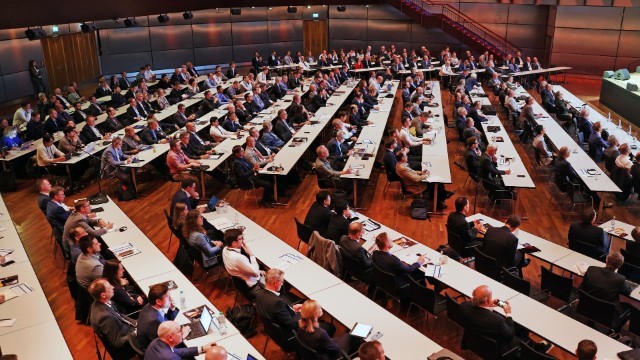
Hari Bisnis Teknologi secara tradisional membuka kongres dengan beberapa presentasi tentang situasi pasar.
Dr. Thierry Robin (TEMATYS) melihat pertumbuhan moderat di pasar laser, memproyeksikan peningkatan dari US$14,5 miliar (2024) menjadi lebih dari US$15,5 miliar (2025).
Sedangkan Dr. Stefan Ruppik (Coherent), dari dewan Kelompok Kerja tentang Laser dan Sistem Laser untuk Pemrosesan Material di dalam VDMA (Federasi Teknik Jerman), melihat tren yang sangat mirip, dengan pertumbuhan 4 persen di pasar global untuk sistem pemrosesan material laser.
Sementara Dr. Henrikki Pantsar (pada saat berbicara dia dari perusahaan TRUMPF) menunjukkan bahwa investasi oleh produsen otomotif di Amerika Serikat semakin anjlok.
Akan tetapi, pengeluaran tinggi untuk pusat data baru menjanjikan pertumbuhan pendapatan bagi produsen laser.
Presentasi Dr. Bo Gu (dari perusahaan BOS Photonics) membahas pasar laser di China sangat dinantikan oleh dunia.
Pasar di China terus mengalami pertumbuhan yang solid, seperti yang diperlihatkan pada pameran dagang bertajuk LASER Shanghai, jelas Dr. Bo Gu, mencetak rekor baru pada bulan Maret 2026 dengan 1.500 peserta pameran dan 58.000 pengunjung.
Dr. Bo memperkirakan pertumbuhan 6 hingga 7 persen per tahun di pasar China untuk sistem pemrosesan material laser baik untuk tahun 2025 maupun 2026.
Pasar laser serat tumbuh sebesar 9,8 persen, sementara pasar laser pulsa ultra pendek (USP) telah mengalami peningkatan yang lebih mengesankan sebesar 14,7 persen.
Namun, angka yang dibeberkan oleh Dr. Bo Gu tentang pangsa pasar produsen China di pasar domestik mereka patut diperhatikan.
Untuk laser dengan daya 3 hingga 6 kW, angka ini adalah 98 persen, dan untuk >10 kW sekitar 80 persen. Dengan demikian, pasar laser China berada di tangan domestik.
Bagaimana Implementasi Revolusi Industri: Mobil Listrik, Energi, dan Teknologi Medis? Silakan lanjut memahaminya pada artikel selanjutnya. #SalamSobatTechnoMachinews
The laser of tomorrow will work autonomously
Press release / June 30, 2026
Increasing automation and new applications are currently shaping industrial laser technology. Particularly in microelectronics, energy, aerospace, and medical technology, high-performance lasers and photonic technologies are opening up new growth prospects. The developments driving the industry were discussed in April at the AKL’26 – International Laser Technology Congress in Aachen. For 30 years, the AKL has been the platform where users, manufacturers, and developers exchange information on the current state and latest trends in industrial laser technology.
The AKL’26 – International Laser Technology Congress took place in Aachen from April 22nd to 24th, 2026. More than 90 speakers informed 544 experts about the current state of industrial laser technology.
© Fraunhofer ILT, Aachen / Andreas Steindl.
The AKL’26 – International Laser Technology Congress took place in Aachen from April 22nd to 24th, 2026. More than 90 speakers informed 544 experts about the current state of industrial laser technology.
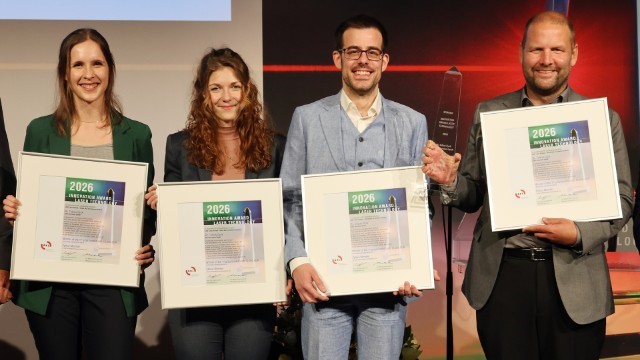
The team from 4Jet microtech GmbH in Alsdorf won first prize at this year’s Innovation Award Laser Technology for their innovative process for large-area microstructuring.
© Fraunhofer ILT, Aachen / Andreas Steindl.
The team from 4Jet microtech GmbH in Alsdorf won first prize at this year’s Innovation Award Laser Technology for their innovative process for large-area microstructuring.
The “Laser Technology Live” event at the Fraunhofer ILT was very well attended. Researchers presented over 60 research projects there as part of AKL’26.
© Fraunhofer ILT, Aachen / Andreas Steindl.
The “Laser Technology Live” event at the Fraunhofer ILT was very well attended. Researchers presented over 60 research projects there as part of AKL’26.
Subdued growth in the laser market
The Technology Business Day traditionally opens the congress with several presentations on the market situation. Dr. Thierry Robin (TEMATYS) sees moderate growth in the laser market, projecting an increase from USD 14.5 billion (2024) to over USD 15.5 billion (2025). Dr. Stefan Ruppik (Coherent), from the board of the Working Group on Lasers and Laser Systems for Material Processing within the VDMA (German Engineering Federation), sees a very similar trend, with 4 percent growth in the global market for laser material processing systems. Dr. Henrikki Pantsar (then with TRUMPF) pointed out that investments by automotive manufacturers in the USA have plummeted. However, the high expenditures for new data centers promise growing revenues for laser manufacturers.
Dr. Bo Gu’s (BOS Photonics) presentation on the Chinese laser market was eagerly anticipated. The market continues to experience solid growth, as evidenced by its trade fairs: LASER Shanghai, Gu explained, set new records in March with 1,500 exhibitors and 58,000 visitors. He forecasts growth of 6 to 7 percent annually in the Chinese market for laser material processing systems for both 2025 and 2026. The fiber laser market has grown by 9.8 percent, while the market for ultrashort pulse (USP) lasers has seen an even more impressive 14.7 percent increase.
However, Gus’s figures on the market share of Chinese manufacturers in their home market were noteworthy: For lasers with 3 to 6 kW power, this figure is 98 percent, and for >10 kW it is around 80 percent. Thus, the Chinese laser market is firmly in domestic hands.
Photonics as a cross-cutting technology
While sales of laser-based machine tools are typically estimated at between 10 and 20 billion euros, the market for laser-enabled products is worth trillions. No smartphone, no computer chip, and hardly any car are manufactured today without the use of laser technology. Photonics is the cross-cutting technology that, with the help of lasers, optical components, and complex processes, enables progress in these fields.
In the Gerd Herziger Session of AKL’26, under the heading ” New Perspectives for Lasers in Science and Industry,” trends in the application of photonic technologies were discussed. Trevor Ness (IPG Photonics) presented a clear vision: “The laser will become integrated, scalable, and intelligent.” Robots will achieve significant productivity gains with lasers and will be able to work even where humans cannot.
The photonic components and technologies for this are currently being developed. They are increasingly digitized and offer ever higher power outputs. “The average power of ultrashort pulse (USP) lasers,” says Dr. Jochen Stollenwerk, acting head of the Fraunhofer ILT in Aachen, “is reaching the double-digit kilowatt (kW) range with the developments in the Fraunhofer Cluster of Excellence Advanced Photon Sources – CAPS.” For continuous-wave lasers, the power output is now even over 100 kW, as representatives from various companies have reported.
Professor Constantin Häfner, Fraunhofer Board Member for Research and Transfer, offered a broader perspective. His focus was on fusion power plants and how they could be implemented in Germany. He argued that they would also significantly transform the laser market: the cost of laser diodes for just a few fusion power plants would already exceed the volume of the current laser market, Häfner explained. This primarily means that component costs must decrease considerably in the future.
Lasers in the energy sector
With its Fusion Action Plan, the German government not only pledged more than two billion euros for fusion research, but also formalized its plan to build the world’s first fusion power plant in Germany. In his plenary address, Constantin Häfner discussed the significance of the emerging fusion ecosystems for the future of fusion research in Germany: the pooling of national expertise from academia to industry to achieve common goals.
The complex technological challenges offer enormous potential for the development of spin-off markets and growth in the photonics market, from industrial dry processes to space applications and the defense sector.
The topic of fusion research was accordingly explored in depth in an entire session at AKL’26. Among other things, Prof. Markus Roth (TU Darmstadt, Focused Energy) presented his plans for a laser fusion facility at the Biblis site.
“Standard” high-power lasers are already used in power plant construction: “The energy sector is one of the first areas of application for laser systems with over 50 kW of power,” states Dr. Alexander Olowinsky, Head of the Joining and Cutting Department at the Fraunhofer ILT. Such laser power can be used to cut thick steel walls during the dismantling of nuclear power plants or to cut doors in wind turbines. New containers with walls several decimeters thick can also be welded with them.
Visitors to the congress were able to view a 50 kW system as part of the “Laser Technology Live” event on April 23, 2026 at Fraunhofer ILT, the largest R&D laser facility in Europe.
Automotive technology on the path to autonomous manufacturing
Automobile manufacturing is now highly automated. Lasers, as digital tools, fully demonstrate their advantages in this context. In his presentation, “Next-generation battery production and challenges for laser technology,” Dr. Andreas Russ (Bosch Manufacturing Solutions) showed what is possible today. Compared to 2015, both battery and machine sizes have multiplied. At the same time, the machines are becoming increasingly intelligent. The production line is networked, utilizes digital twins, and can make autonomous decisions based on simulations.
At Markus Harke’s (Volkswagen) booth, visitors could see how a German process is literally changing the world. Using the “high-speed laser cladding” developed at the Fraunhofer ILT, they are manufacturing brake discs that produce 90 percent less particulate matter. This not only protects the environment but also meets the Euro 7 emissions standard. Furthermore, it enables largely automated production, which is now beginning its global success. “With these high production volumes, the laser is no longer the main cost driver,” commented Dr. Thomas Schopphoven, Head of the Laser Cladding Department at the Fraunhofer ILT. “It’s primarily the material costs for the filler materials.”
Lasers in aviation save costs and emissions.
Up to 3 percent fuel savings for aircraft – that’s the promise of the sharkskin coating developed by 4Jet GmbH from Alsdorf near Aachen. The technology, which won the “Innovation Award Laser Technology 2026,” enables large-area micro-machining using a CO2 laser . It utilizes interference patterns for processing, allowing over 1,000 “riblet” coatings to be created in a single operation. This allows for the application of microstructures across large surfaces, reducing drag. The company now has more than 800 systems in operation, used in the aerospace, semiconductor, and solar industries.
In addition, many laser processes, especially laser cladding, have found practical application. Companies like Rolls Royce successfully use these processes in engine repair and are constantly refining them.
57 exhibitors presented themselves at the conference-accompanying exhibition of AKL’26 – the opportunity for exchange was actively used.
© Fraunhofer ILT, Aachen / Andreas Steindl.
57 exhibitors presented themselves at the conference-accompanying exhibition of AKL’26 – the opportunity for exchange was actively used.
Fraunhofer ILT in Aachen is developing a highly complex laser-optical system for a quantum computer that is currently being built at the 5th Physics Institute of the University of Stuttgart.
© Fraunhofer ILT, Aachen / Ralf Baumgarten.
Fraunhofer ILT in Aachen is developing a highly complex laser-optical system for a quantum computer that is currently being built at the 5th Physics Institute of the University of Stuttgart.
Visualization of a diode laser module with beam shaping for pumping stack-of-plate amplifiers in high-energy lasers. Such diode laser pumping modules are considered a key component for future fusion power plants.
© Fraunhofer ILT, Aachen.
Visualization of a diode laser module with beam shaping for pumping stack-of-plate amplifiers in high-energy lasers. Such diode laser pumping modules are considered a key component for future fusion power plants.
24/7 laser use in microelectronics
Initially, the laser was a solution sought to solve a problem. Today, laser technology, in its various forms, is involved in the mass production of consumer electronics. This is evident in display manufacturing, as demonstrated in Oliver Haupt’s (Coherent) presentation on the future of laser use in micro-LEDs. In microelectronics, the next breakthrough is already on the horizon.
In his presentation, Dr. Christian Buchner (SCHMID Group) demonstrated that glass substrates offer a solution to the bottleneck of increasing data transfer rates between processors and high-performance memory (HBM). Glass is robust, inexpensive, and well-established in semiconductor processes. Laser-induced etching (Selective Laser-induced Etching, SLE) now allows for the precise drilling of through-glass vias in transparent materials such as glass. This industrial process enables excellent surface qualities and high aspect ratios.
“Another trend in microelectronics is beam shaping,” explains Dr. Dennis Haasler, Head of the Surface Technology and Ablation Department at Fraunhofer ILT. “Both special beam shapes, such as those used in Bessel beams, and multi-beam systems are increasingly being used industrially.” The latter allow for the parallel application of, in particular, ultrashort laser pulses.
Lasers in medical technology bring more safety for patients.
From diagnostics to therapy, optical technologies have become indispensable in everyday clinical practice. The tangible benefits, as presented by Prof. Christian Blume, neurosurgeon at Aachen University Hospital, are truly impressive. Using complex spinal surgeries as examples, he demonstrated how the success rate has increased from 40 percent (freehand surgery) to 99.5 percent in recent years. The breakthrough came with intraoperative computed tomography. The SaveCut project promises a further step toward greater safety. There, experts from the Fraunhofer Institute for Laser Technology (ILT) are collaborating with him to develop a robot-assisted laser osteotome for minimally invasive spinal surgery.
Similarly significant progress is being made in implantology. Additive laser processes have been used for some time to create customized implant shapes. In his presentation, Frank Reinauer (KLS Martin) demonstrated how digital workflows make patient-specific solutions with selective laser melting even more effective. Five to fifteen implants can be produced in a single pass. New resorbable materials such as magnesium alloys or polyethylene promote bone tissue growth. The implant gradually dissolves at these points.
Quo vadis quantum technology?
“We have gained an excellent overview of some of the most promising platforms for scalable quantum computers – presented by leading companies and research institutions from Germany and Europe,” summarizes Dr. Bernd Jungbluth, reflecting on his impression of the first day of the AKL’26 conference.
The focus was primarily on recent advances in various hardware platforms for quantum computers – including those based on neutral atoms at planqc. Prof. Stephanie Wehner (Quantum Internet Alliance) also provided an overview of the current state of the quantum internet and outlined initial short-term application perspectives, such as in the area of coordinated systems. In the long term, the networking of quantum computers will also gain in importance. Photonic interfaces are considered a key technology for this, as they enable the transmission of quantum information over fiber optic networks and can connect different quantum platforms.
AI makes lasers faster, more flexible, and more autonomous.
The final presentation of the conference was also one of the most exciting: Prof. Carlo Holly (RWTH Aachen University and Fraunhofer ILT) spoke about “AI-driven innovation in photonics.” This topic now permeates all parts of the supply chain, from the design of optical components and quality assurance to the simulation of complex processes using digital twins.
Among the new developments in his research are advances in self-supervised learning, which reduces the time required for AI training in quality control from weeks to minutes. Also exciting was a new AI-generated optic that allows for the changing of any beam profile during the process without mechanical components.
Ultimately, he envisions how AI will permeate all areas of laser technology. From planning and process control, where only AI can process the flood of data, to autonomous control. The self-learning machine is coming, as are autonomous laboratories and factories. The technology for this is being developed in Aachen.
The next AKL – International Laser Technology Congress will take place from May 3rd to 5th, 2028 in Aachen.